

TL;DR: zero-click search is the default now. About 68% of US Google searches end without a click. SEO still works, but success is measured differently.
It means being named in AI answers, showing up wherever your buyers research, and getting fewer, better visits that turn into leads.
Most sites are still measuring the old way.
Part 1 of 3 on zero-click marketing. Part 2 covers SEO reporting when attribution is broken. Part 3 covers the public record AI pulls from when it describes your brand.
The alligator in your Search Console: impressions up, clicks down
Open Google Search Console and look at the last year. For a lot of B2B sites, the two lines have pulled apart. Impressions go up. Clicks don’t follow.
Here’s one B2B company I started working with in August. Their GSC data from October 2025 to July 2026: Impressions rose 70%. Clicks fell 27%.
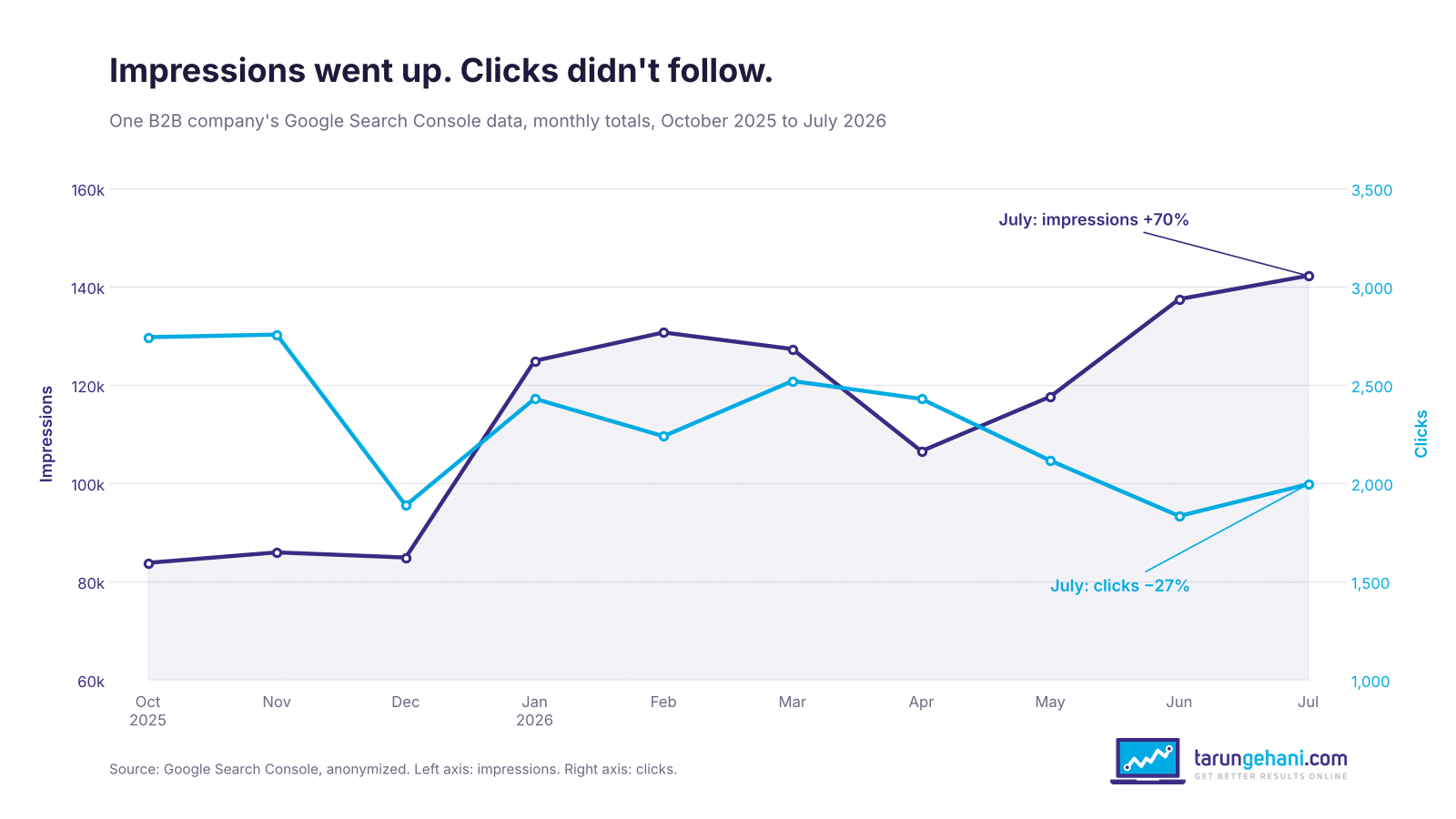
Nothing broke. Search engines just stopped pointing people to websites. They answer the question right on the page. Your content can still shape that answer, but your brand might not get the credit or the click.
So the question every founder and marketing lead is asking makes sense: if clicks are shrinking, what does SEO success look like now?
How common is zero-click search now?
About two out of three US Google searches now end without a click to any website. As of November 2026, the latest figure is 68%: SparkToro’s 2026 study measured zero-click searches at 68.01% of US Google searches from January to April 2026, up from 60.45% in 2024.
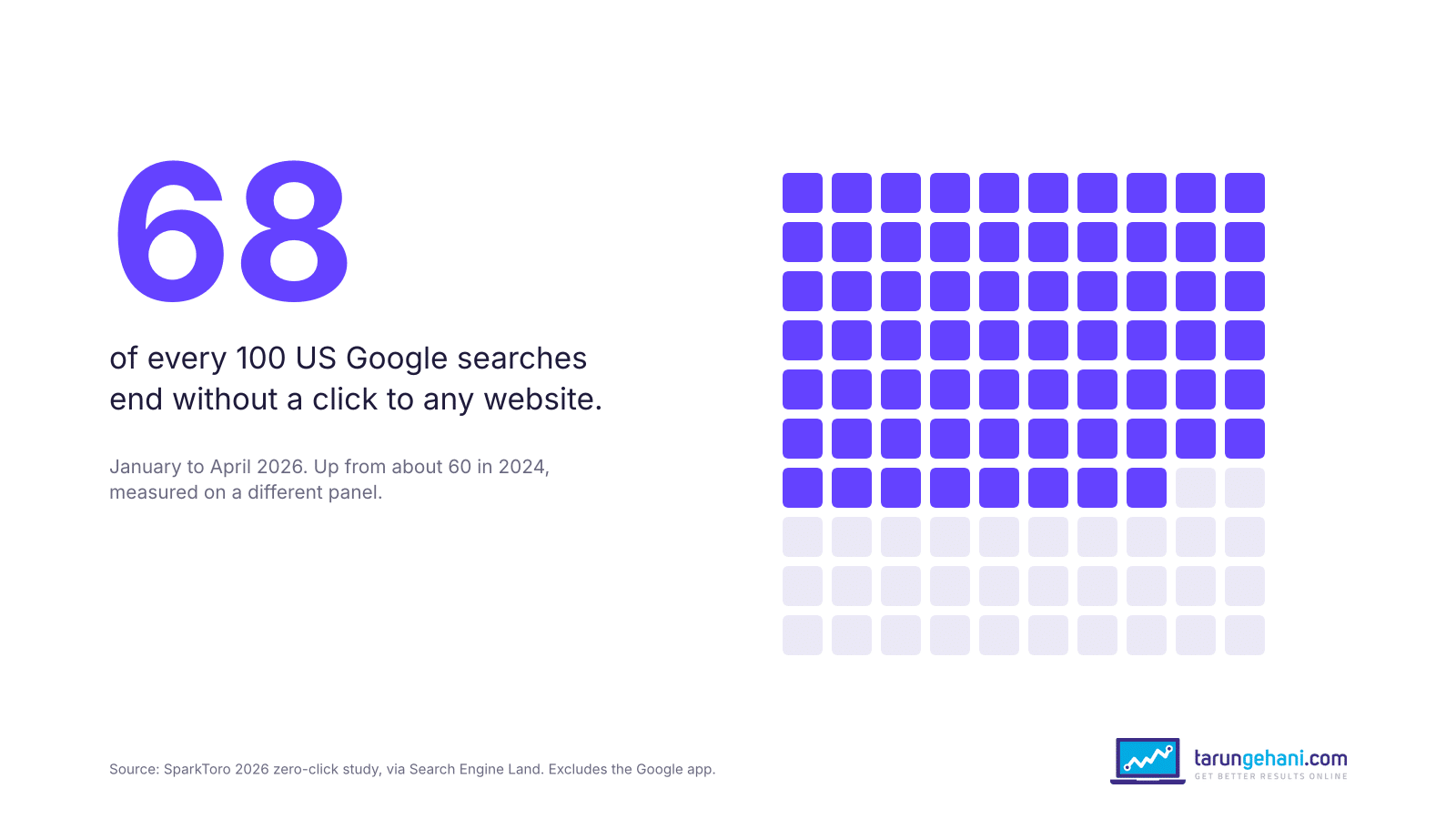
One caveat worth knowing: the 2024 number came from a different data panel than the 2026 one, so the jump isn’t a clean year-over-year comparison. The direction is clear. The exact size of the change is less certain.
Search also isn’t only Google anymore. On desktop in late 2025, about 80% of searches happened on traditional engines, about 10% on commerce sites like Amazon, and 3.2% in AI tools (SparkToro, March 2026).
AI tools are a small share of searches today. The questions buyers bring to them are not small, though: which vendors to shortlist, how two options compare, what a project should cost. A small share of searches can still be a large share of decisions.
Search is a behavior that happens across platforms. Your buyers search on Google, in ChatGPT, on LinkedIn, on review sites, and in Reddit threads. Most of those places answer them without sending them anywhere.
Your first impression. Now it happens in an AI answer.
Your homepage used to be the first impression. Now the first impression happens before anyone visits: in an AI Overview, a ChatGPT answer, a LinkedIn post, or a Reddit thread.
Amanda Natividad of SparkToro made this point in her MicroConf 2026 talk (video). It matches what I see on discovery calls. The prospect has usually already asked ChatGPT who the credible options are, and the conversation starts from whatever it said.
That changes what your website is for. It’s still where people convert. But by the time they arrive, they’ve often already formed an opinion from what other sources said about you.
SEO now has two jobs. Earn the visit when someone needs to click. And shape the answer when they don’t.
Is SEO dead?
No. SEO isn’t dead (again). Classic “10 blue links” SEO is obviously no longer the game, but the fundamentals still decide who gets cited. Titles, headings, clear structure, site speed, and crawlability help people use your pages. They also decide whether AI tools can understand your content well enough to quote it.
The KPIs and measurement are what changed. Rankings and clicks still count. Next to them sits a newer question: when a buyer asks an AI tool about your category, are you in the answer? That’s AI visibility, and it’s now a KPI of its own.
What SEO success looks like now: AI visibility and the right traffic
Click-through rates are under pressure, and that’s real, but being cited in AI answers is now its own KPI. Even when fewer people click, being named as a source builds credibility and brand recognition that pay off across channels.
Three things now define success.
- You’re the answer, or part of it. When a buyer asks an AI tool about your category, your brand shows up, and it’s described accurately.
- Compound visibility. Search doesn’t live on its own anymore. If your brand shows up in Google, in AI tools, on LinkedIn, and on review sites, each one reinforces the others. The return comes from being present wherever your buyers make decisions.
- Bottom-of-funnel content that converts. With so much noise at the top of the funnel, the pages that matter most are comparisons, case studies, and solution guides. That’s where buyers already have intent, and where SEO moves revenue.
Fewer pages can win. On one B2B site I worked on, the blog had grown to a few hundred posts. We deleted about a third of them and merged many more. Every merged page got rebuilt: updated facts, clearer structure, and formatting that both search engines and AI tools can parse. Over the next nine months, rankings improved because the site stopped competing with itself for the same queries. Total traffic went down. Leads and conversions went up, and revenue followed, because the visitors who still came were the ones looking to buy.
Find It, Fix It, Prove It in a zero-click world
The biggest challenge right now is uncertainty. Businesses don’t know whether to chase AI, double down on Google, or put more into social. The answer is a balanced plan, and it runs in three steps.
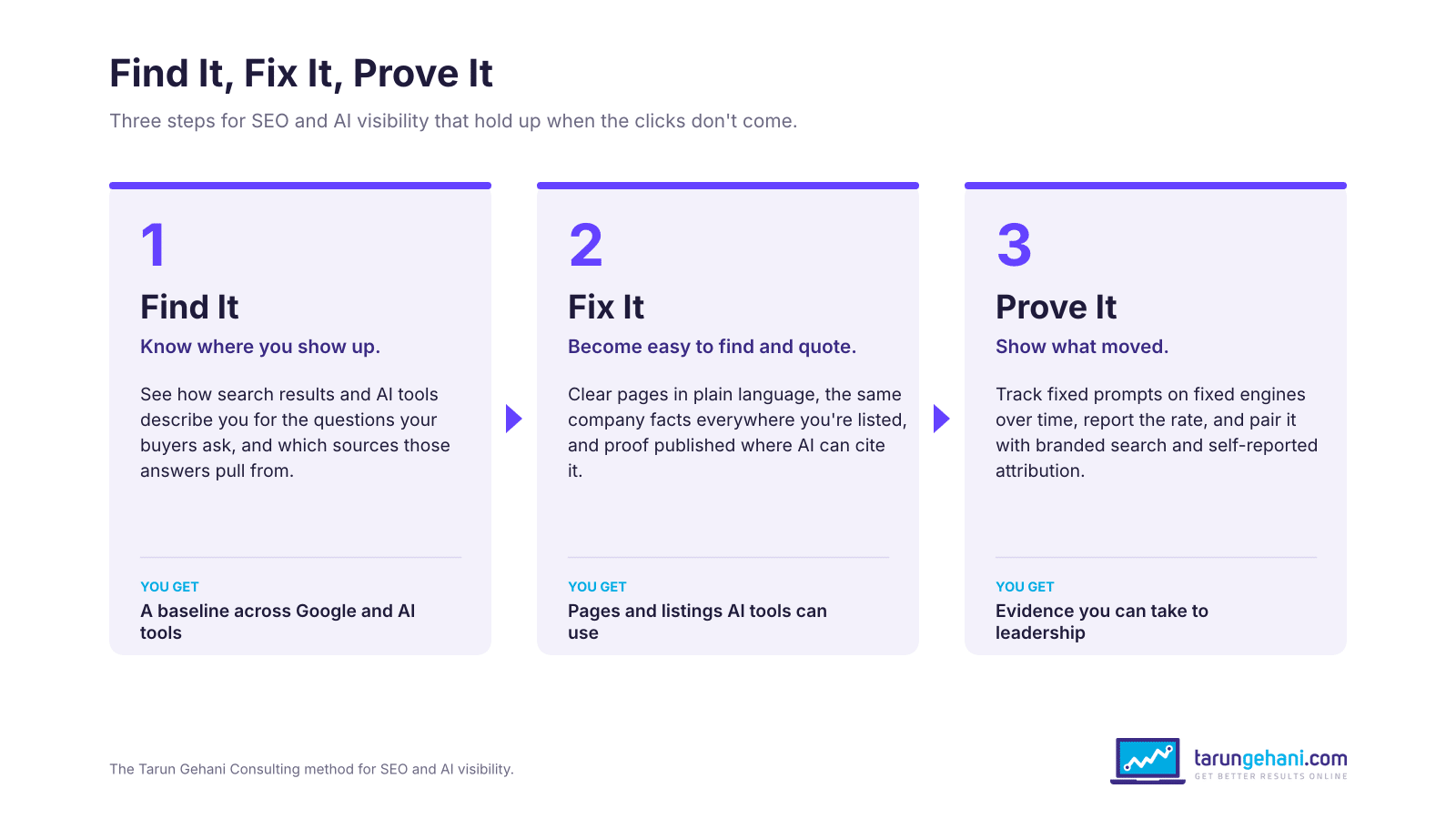
Find It: see where you show up today
Check how AI tools and search results describe you for the questions your buyers ask. Look at the public record those answers pull from: reviews, directories, forum threads, press, and third-party mentions. Part 3 of this series covers that public record in depth.
Fix It: make your expertise easy to find and quote
That means clear, well-structured pages written in plain language, the same facts about your company everywhere it’s listed, and proof points published on public pages where AI can find and cite them.
Here’s what a consulting engagement built around this looks like: modern SEO consulting in the age of AI.
Prove It: measure with repeated runs
AI answers change from one run to the next. Asking ChatGPT once and taking a screenshot proves almost nothing. Here’s one buyer question tracked daily for 30 days across three AI engines. The brand was named in 51 of 88 answers, and the rate ran from 22 of 30 on ChatGPT down to 9 of 30 on the weakest engine.
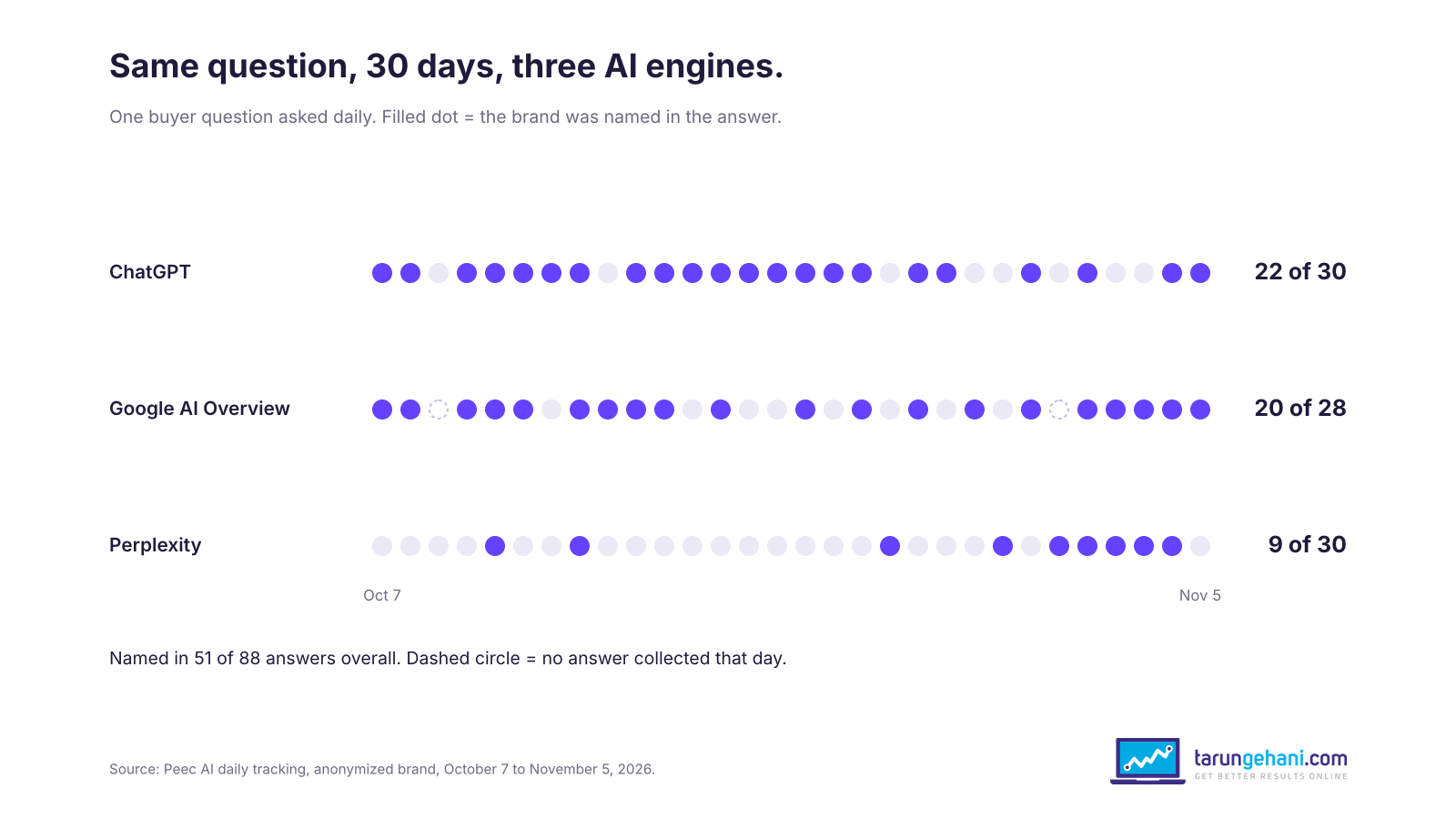
On any single day, a screenshot could have shown either result. Track a fixed set of prompts on fixed engines, run them repeatedly, and report the rate. Pair that with leading indicators like branded search and self-reported attribution. Part 2 of this series walks through the full reporting stack.
How to measure SEO success, today
You can start on all of this in an afternoon.
- Pull 16 months of Search Console data. Chart impressions against clicks. If they’ve split, you’re seeing zero-click search in your own numbers.
- Check your branded impressions. Rising branded search is one of the clearer signs that visibility you can’t click on is still working.
- Run five buyer questions through four AI tools. Use ChatGPT, Google AI Overviews, Gemini, and Copilot. Write down whether you’re named, how you’re described, and who’s named instead. Then run them again next week.
- Add a “How did you hear about us?” field to your contact or booking form. It catches the AI answers, podcasts, and LinkedIn posts your analytics can’t see.
Want the longer plan?
Here’s what a strong SEO roadmap looks like in the first 90 days.
FAQ
What is a zero-click search?
A search where the person gets their answer on the results page, or from an AI tool, and doesn’t click through to any website. In 2026, that’s about 68% of US Google searches.
What is AI visibility?
How often, and how accurately, AI tools like ChatGPT, Gemini, and Google’s AI Overviews name your brand when buyers ask about your category. You track it by running the same prompts repeatedly and reporting the rate.
How do I measure SEO when clicks are falling?
Look at visibility, engagement, and conversions together: impressions, branded search, AI citation rates, leads, and self-reported attribution. Rankings and clicks still count. They’re one part of the picture now.
How do I know if zero-click search is affecting my site?
Pull 16 months of Search Console data and chart impressions against clicks. If impressions keep rising while clicks flatten or fall, zero-click is showing up in your own numbers.
Not sure what to fix first?
Start with a Sit-In, a paid strategy session. We’ll look at how your site shows up in Google and AI tools today and leave with the top three changes, why each one matters, and the first step your team can take. It’s $400, credited toward your next service if you book within 30 days.
If you want the full picture across every prompt and engine, that’s The Chart.
The Search Shift
Search is changing.
Keep up in 10 min every other week.
Written for founders and marketing leads. Learn what changed in Google and AI search and what to do about it.
